
When you are crafting furniture, a shed or other building, trim pieces, or other structures and projects, you will find yourself creating various joints. Joints are simply the places where two pieces of wood fit together or connect with each other.
In order to have a sturdy, solid piece of furniture, you need each connection point to be the strongest wood joint you can achieve. What wood joint is the strongest? We will explore various options in this guide so you can choose the best wood joint for strength and succeed in creating a durable project.
3 Factors to Consider
There are three factors to consider when you are looking to form the strongest wood joint. First, you need to consider the actual structure of the wood joint itself, as in the design, or the way the two pieces of wood fit together.
Next, you need to consider the type of glue that forms the strongest bond for a wood joint.
And lastly, you will need to take into account the type of wood you are using. The strength of the lumber itself helps you determine the best wood joint for strength. Woods like maple, walnut, birch, oak, cherry, and pine are often used for furniture, while cedar, spruce, fir, oak, and pine work well for framing a house.
Popular Kinds of Strong Wood Joints
Let’s go over a few of the strongest types of wood joints. Some of these have a specific purpose, while others can be used in various ways for multiple kinds of projects. Some may also take more time to design and cut to create a precise fit. It’s up to you to decide which type of durable joint you would like to use for your project.
The Lap Joint
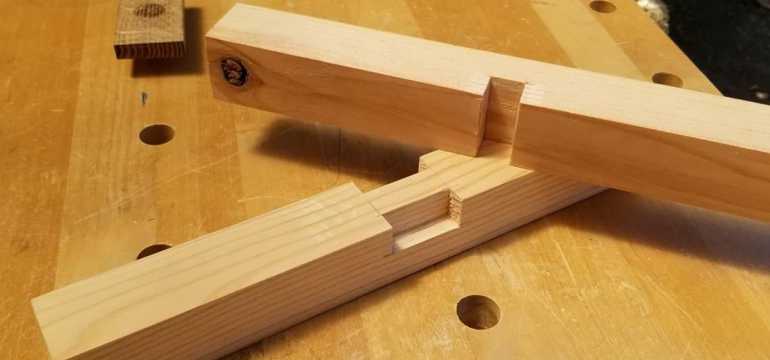 For a lap joint, two pieces of wood are cut so that they overlap. There are two main types of lap joints. One kind is the full lap joint, which is just one board laid over another and secured with nails or screws. Glue may or may not be a part of the bonding process for this joint. The full lap joint is often used to reinforce existing structures with additional pieces of wood. It’s also popular for workers who are framing houses or erecting fences.
The notched lap joint involves cutting into each piece of wood so that they fit smoothly one over the other. For example, for a half-lap notched joint, a section of the end of one may be cut halfway through, and then a corresponding section will be cut from the other.
When the two pieces fit together, they form the full thickness of the piece, and the edges are flush with each other. The notch depth can change depending on the project and how much overlap you want. Notched lap joints are considered to be stronger than full lap joints. They are used in framing for homes, furniture, and other projects.
The Miter Joint
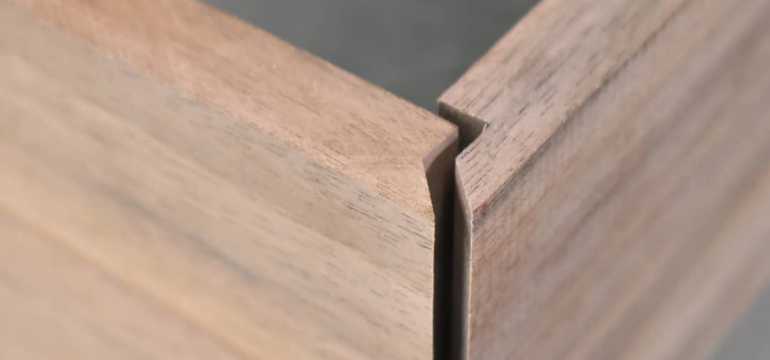 A miter joint is created when the ends of two boards are cut at angles to fit together. Let’s say you have a couple of two by fours, and you want to make a picture frame, as a simple example. So to create a miter joint, you would cut the end of each two by four at a forty-five-degree angle so that when they are put together, they create a perfect ninety-degree angle, a clear-cut corner. You can use this technique when creating frames for paintings, pictures, or even furniture, such as small tables.
To secure the bond of a miter joint, you would apply glue along the cut forty-five degree angled edges of each piece of wood. Then you would press them together and allow them to dry, securing them even more firmly with screws or nails. Both types of fastening (glue and nails/screws) should be used to ensure the security of the joint.
Not all miter joints form right angles. You can create miter joints at any angle you want, depending on your needs for the project. Just be sure to mark and measure carefully before you cut. An example of a non-90-degree miter joint would be an octagonal shaped frame, perhaps for a mirror. These wood pieces would be cut on 22.5-degree angles so that they fit together to form the desired shape. Miter joints are useful for door and window frames and trim, frames for pictures and paintings, and occasionally a small piece of furniture.
The Tongue and Groove Joint
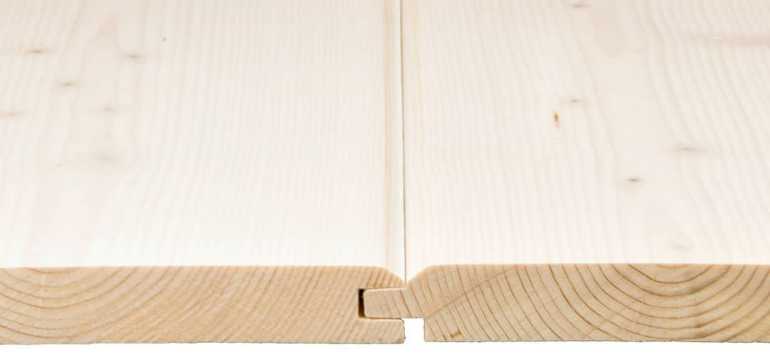 A tongue and groove or tongue-in-groove joint are one of the stronger variations, especially if you are working with flat-lying pieces, such as floorboards. One-piece has a groove or indentation along one side, and the other has a corresponding ridge or protrusion that fits into that groove.
This creates a solid fit between the two pieces, and they can then be blind-nailed through the tongue, so the nails don’t show. In some cases, as with modern precut flooring, you may not even need any nails because the tongue and groove just snap together.
The Mortise and Tenon Joint
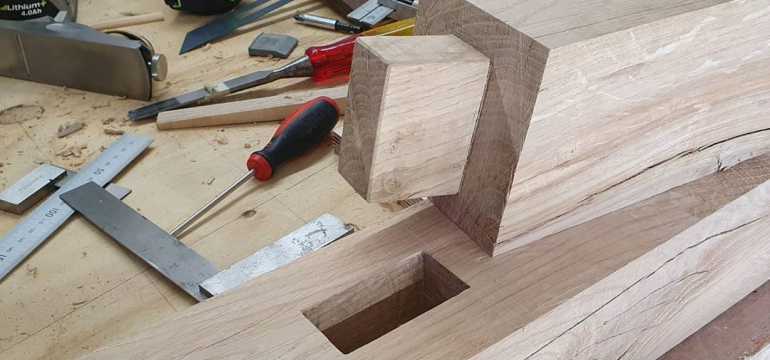 One of the strongest wood joints for upright pieces is the mortise and tenon joint, often used for crafting wood furniture. For this joint, a projection is crafted or cut on the end of one piece, such as a chair leg, and then a corresponding socket is made on the other piece. This is perfect for items with perpendicular appendages, such as chair legs or table legs. Adding glue is ideal to ensure that the protruding piece doesn’t work itself out of the socket.
The Dovetail Joint
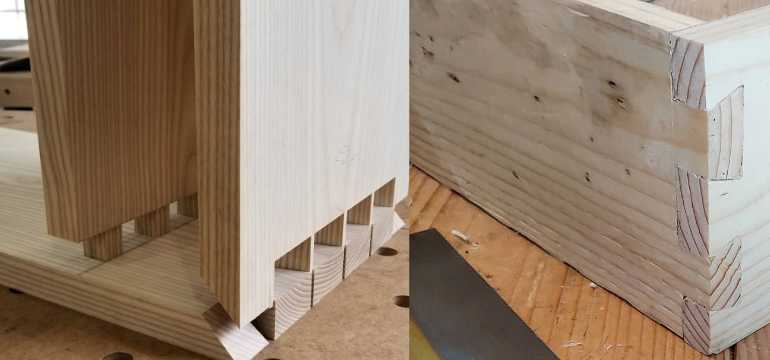 The strongest bond for a wood joint in furniture is widely considered to be the dovetail joint. A specific type of dovetail joint, called the half-blind dovetail, involves a series of wedge-shaped sections that interlock, so they are very difficult to work apart once they’re in place. The wedge-shaped sockets are cut along the edge of one piece of wood, while the wedge-shaped tails are cut into the other. The two sections must be glued together and then clamped until they dry securely.
Some dovetail joints do not involve wedge shapes, but simply involve a zipper-type structure of teeth cut along the edge of one board that fit into corresponding notches on the other boards. Dovetail joints used to be carefully cut by hand, but today they can be crafted using a router with a dovetail jig. They are very popular for drawers, but they are also used for a number of other connection points in furniture and other woodworking projects.
The Rabbet Joint
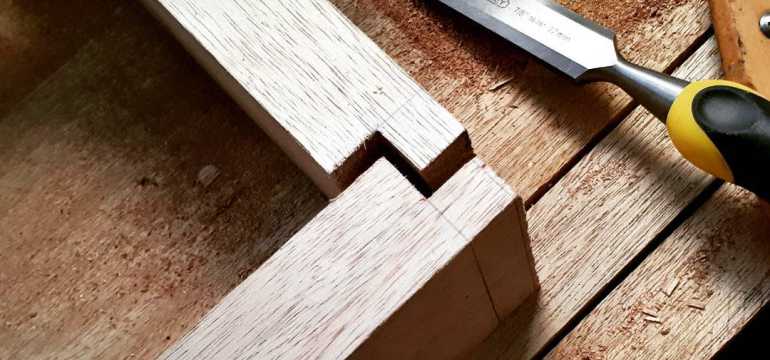 A rabbet joint is a section cut out at the end of a board so that another board’s edge can fit neatly at right angles into it. Rabbet joints are frequently used for cabinetry and box-shaped structures. While they are fairly secure with just nails or screws, it’s a good idea to also use glue for a durable, tough bond.
The rabbet joint is a variation on the dado joint, which simply consists of a square groove cut into one board, shaped to fit the end of another board. Like rabbet joints, dado joints are popular in furniture-making and cabinetry.
The Strongest Bond for a Wood Joint: Glue Types
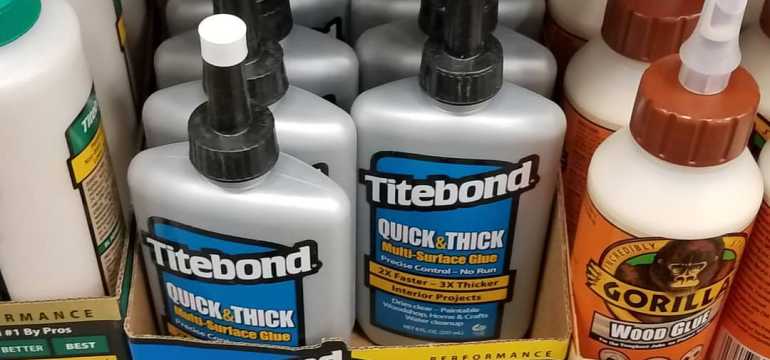
Now it’s time to talk about the types of glue that tend to work best for securing wood joints.
Titebond 5004 II Premium Wood Glue
Number one on the list is Franklin International 5004 Titebond-II Premium Wood Glue. This glue is tough enough to pass ANSI Type II water-resistance testing. It is fine for exterior use since it is so tough. You can sand it easily if necessary. You’ll also find that it sets fairly quickly and offers a very durable bond.
Gorilla Glue
Next up, we have Gorilla Glue. It’s water-based and is extremely popular with carpenters, woodworkers, and hobbyists. It has a reputation for tough, powerful, long-lasting bonds, so it is perfect if you’re looking to create the strongest bond for a wood joint. Its water resistance and natural color are also nice bonuses.
Titebond III 1413 Ultimate Wood Glue
There’s another Titebond product that also works very well to secure joints, and that’s Titebond III 1413 Ultimate Wood Glue. It passed the ANSI/HPVA Type I water-resistance testing, so it is fairly waterproof. Its initial tack or grip is very strong, even before it completely dries and solidifies. That initial tacking power is so important when you are right in the middle of a project! You can trust the glue to start holding things together right away before you have added more fasteners.
Elmer’s E7010 Carpenter’s Interior Wood Glue
Elmer’s glue isn’t just for school kids! The E7010 Carpenter’s Interior Wood Glue is non-toxic, without fumes, and you can clean it up with some water if necessary. When you’re using it, you’ll need to leave it for a 20-30 minute clamp time until it sets, and then it will thoroughly bond in 24 hours. You can sand or paint it as necessary. It’s easy to use and offers excellent adhesive power for wood joints and other applications.
As far as what wood joint is the strongest, the correct answer may differ depending on the project. Generally speaking, the joints that take longer to craft and ensure a tighter fit, like the dovetail joint, are usually among the best wood joints for strength.

- How to Cut Lexan - September 25, 2020
- Mineral Spirits vs. Mineral Oil - September 25, 2020
- Shellac vs. Polyurethane - September 24, 2020